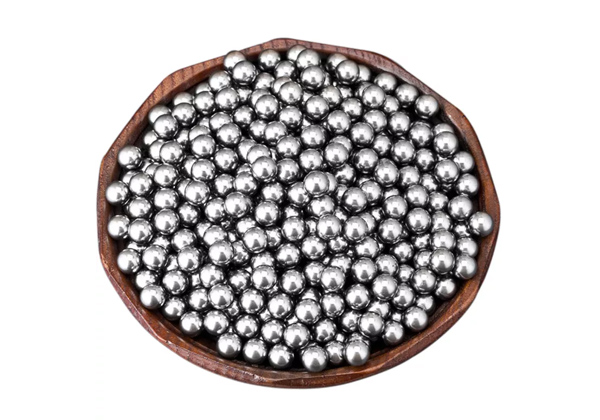
Corrosion resistance: good corrosion resistance to organic compounds and a variety of strong acids such as acetic acid, phosphoric acid, sulfuric acid, and seawater. They suffer pitting and crack corrosion when temperatures exceed 60°C. They do not resist contact with hydrochloric acid, ferric chloride, or magnesium chloride. They have higher corrosion resistance than AISI 304 balls and are provided in the passivated condition.
| Physical Property |
| Corrosion Resistant |
Excellent |
| Wear Resistant |
Fair |
| Magnetism |
Slightly |
<td width=”18.1400%”>HardnessHRC 20 – 39
| Technical Data |
| Density |
7.95g/m3 |
| Young’s Modulus |
200GPa |
| Tensile Strength |
550-1250MPa |
| Chemical Composition |
| Type |
%C max |
%Si max |
%Mn max |
%P max |
%S max |
%Cr |
%Ni |
%N |
| 316 |
0.080 |
1.00 |
2.00 |
0.045 |
0.030 |
16.00-18.00 |
10.00-14.00 |
2.00-3.00 |
| 316L |
0.030 |
1.00 |
2.00 |
0.045 |
0.030 |
16.00-18.00 |
10.10-14.00 |
2.00-3.00 |
| International Standard |
| USA |
CHN |
GER |
FRA |
UK |
ITA |
RUS |
JAP |
| 316 |
0Cr17Ni12Mo2 |
1.4401 |
Z6CND17.11 |
316S16 |
X5CrNiMo1712-2 |
08KH16N11M3 |
SUS316 |
| 316L |
0Cr19Ni12Mo2 |
1.4404 |
Z3CND17-11-02 |
316S11 |
X2CrNiMo1712-2 |
03KH17N14M2 |
SUS316L |